Docs / Start hereAll pages
01 · Start here
What Hinode is
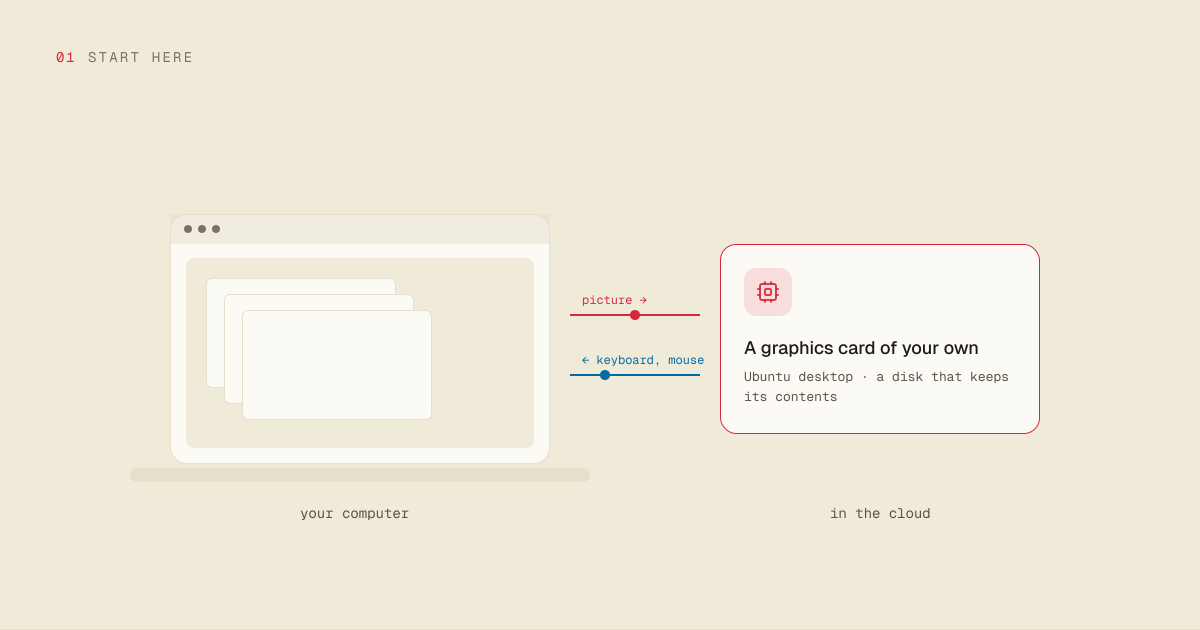
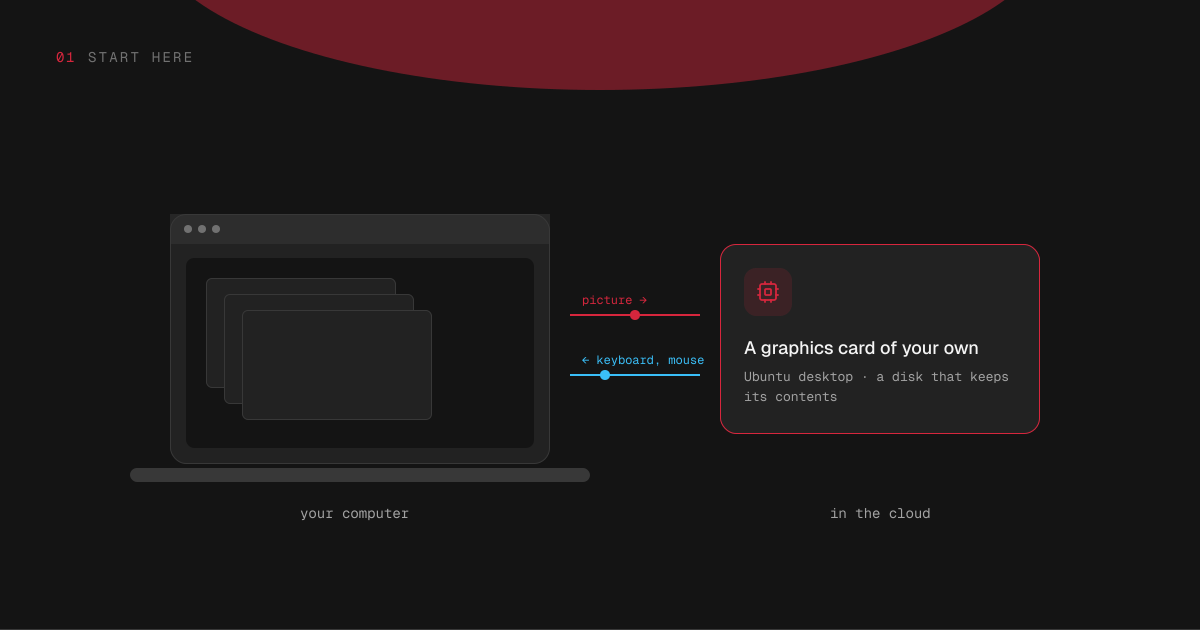
Hinode rents you a Linux computer with a graphics card in it, and keeps it within reach of the computer you already own.
2 min read · prices are today’s
On this page4 sections
It is a real computer, not a notebook interface. You reach it over SSH from a terminal or an editor, open the applications you install on it in your own browser, hand it commands as jobs, or ask an assistant to do any of that for you. The machine keeps its disk between sessions, so what you installed yesterday is still installed tomorrow.
It is built for work that needs a GPU: image and video generation, model training and fine-tuning, inference, and batch work over a dataset.
What you get
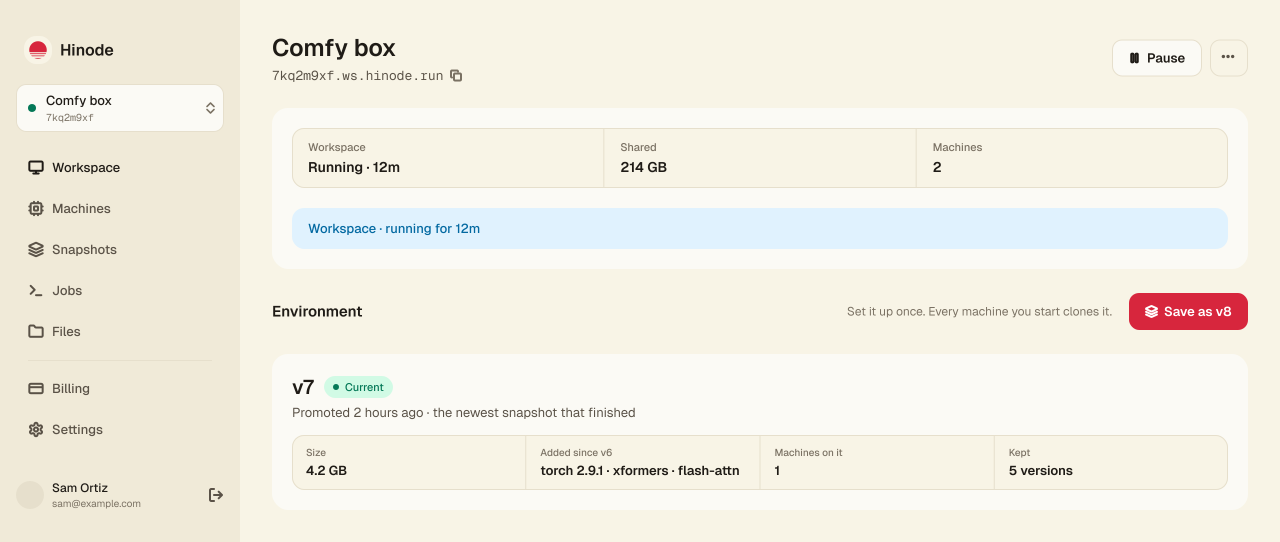
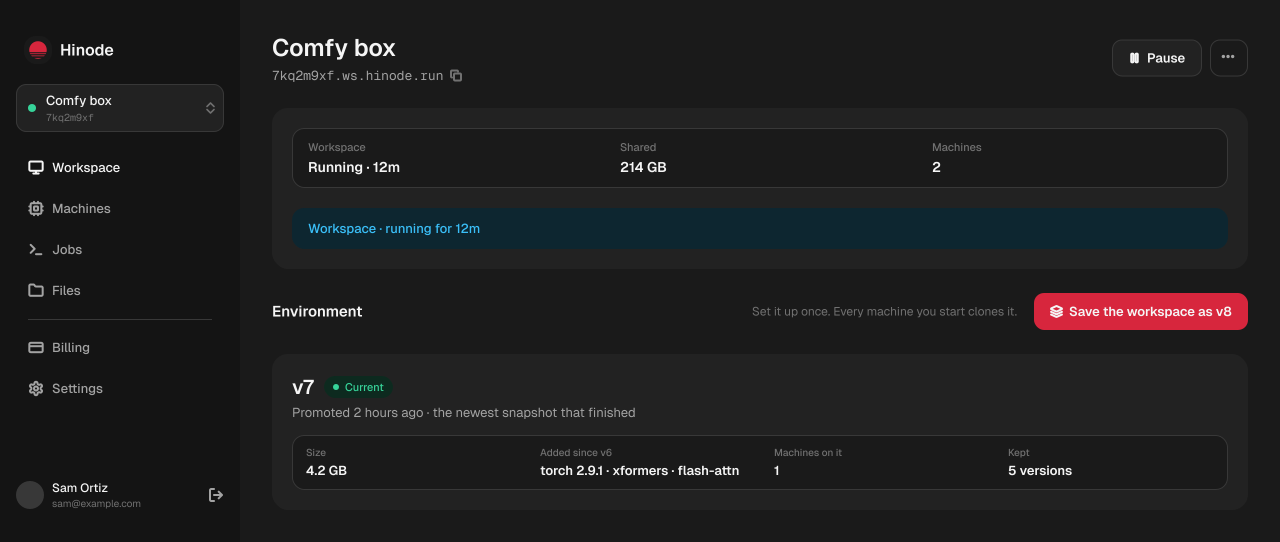
A workspace you keep. It has a name and an address, and a computer with a small slice of a graphics card: it holds your home folder, your files and the programs every machine starts from. It bills while it runs and pauses itself when nobody is using it. It is where your things live, not where the heavy work runs.
Machines you add beside it when you want a whole graphics card, for as long as the work lasts. You choose how much graphics memory and how much system memory each one has. A machine bills while it runs, pauses itself when nobody is using it, and is gone when you delete it.
One place for big files. Models and datasets live where every machine in the workspace can see them, so a machine you add tomorrow already has them.
What it is not
It is not a shared computer. The graphics card in your machine is yours while the machine is running — nothing else is scheduled onto it.
It is not a subscription with an allowance. You are billed for what you run: the workspace at $0.24 an hour and each machine at its own rate, for the time each is running.
It is not a place to be careful about clicking. The expensive thing is a machine that is running, and the workspace and machines pause themselves when nobody is working on them.
Where the machine is
Hinode runs in two places: the United States (us-east-1) and Europe (eu-central-1). A new workspace is created in whichever answers your computer faster, and it stays there — the machines you attach and everything you store are in the same place.
The distance costs you at the keyboard, not at the work. A render takes the same time either way; a terminal on the other side of an ocean answers a little later.
From anywhere
You can check on your workspace from anywhere, including from a phone: see what is running, what it costs, and turn things off.

